AI Feedback Loop Problem (2025)
AI Feedback Loop Problem
- computer science.
- ai feedback loop problem.
- the collapse of ai.
- indeed, an unsolved problem.
- ai gets data from the web, and a lot people are using ai now and post ai generated text, would this create a feedback loop problem.
- grok answer at https://x.com/i/grok/share/y2dUZAlkGB0ERsstAEiSLVB4r
Yes, this scenario does create a significant feedback loop problem in AI development, often referred to as "model collapse." As more AI-generated text floods the web—through users sharing outputs from tools like ChatGPT or Grok—it increasingly contaminates the vast datasets used to train future models. When these models learn from synthetic (AI-produced) data rather than diverse, human-generated content, they tend to lose the richness and variability of real-world information, leading to degraded performance over generations.
How the Feedback Loop Works
- Initial Training: Early AI models are trained on mostly human-created web data.
- Generation and Proliferation: Users generate and post AI content, which gets scraped into new training datasets.
- Recursive Training: Next-generation models ingest this mix, amplifying errors, biases, and simplifications from the AI data.
- Collapse: Outputs become homogenized, repetitive, or nonsensical—models "forget" rare events, produce gibberish, or mimic only common patterns.
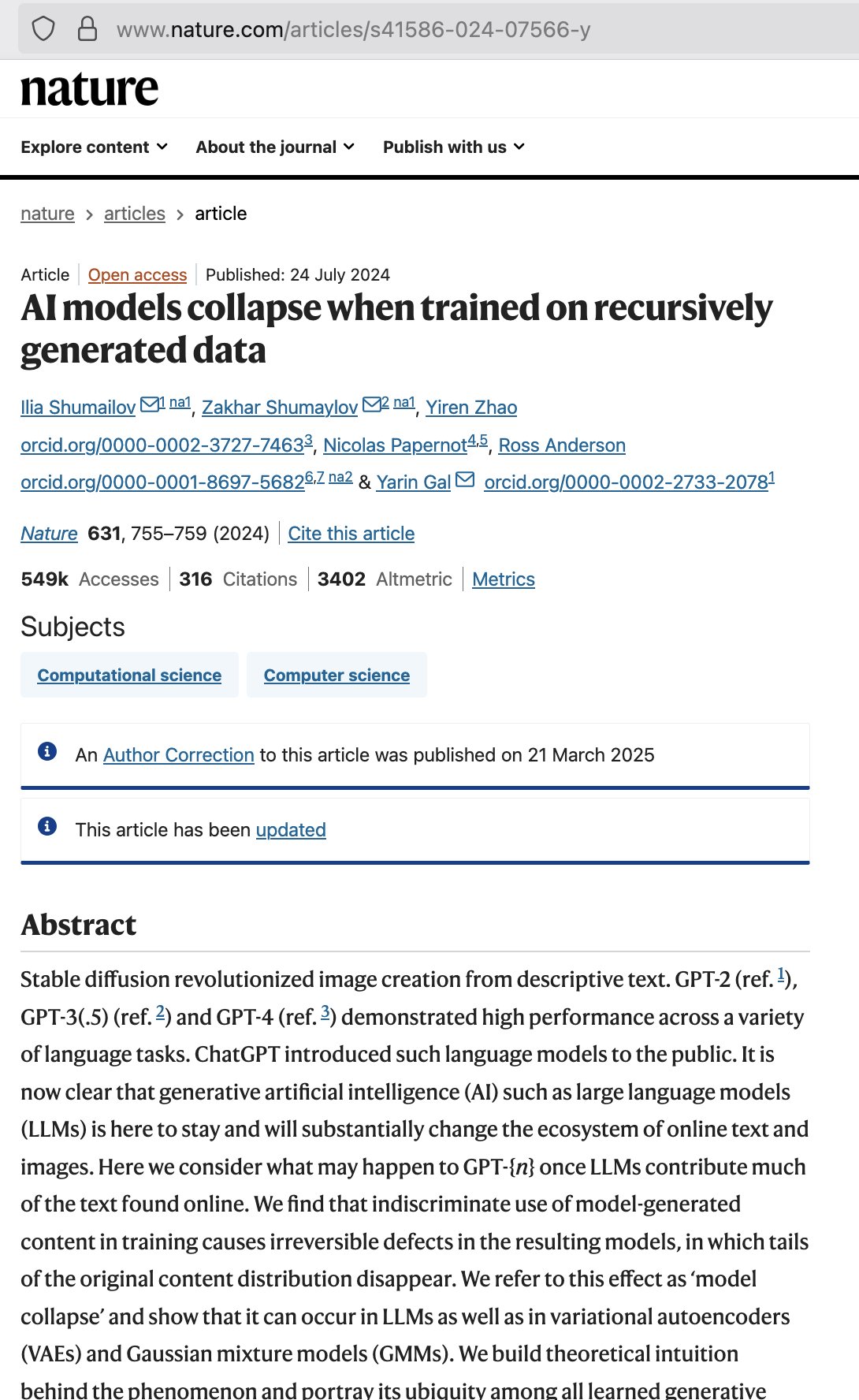
This was rigorously demonstrated in a 2024 Nature study, which showed mathematically that generative AIs malfunction when trained recursively on their own outputs, eventually producing low-quality or biased results. Real-world signs are emerging too: by mid-2025, some models were exhibiting "madness from cannibalism," with outputs falling apart as synthetic data dominates.
Implications
- Quality Degradation: Future AIs could become less creative, accurate, or useful, exacerbating issues like misinformation.
- Data Scarcity: High-quality human data is finite, and web pollution accelerates the crisis.
- Ethical Concerns: It raises questions about "the right to uncontaminated human-generated data," as AI essentially exploits public content without consent.
Potential Solutions
Researchers propose curating datasets to prioritize verified human sources, watermarking AI outputs for easy filtering, or developing techniques to "reconstruct" diversity in synthetic data. However, as AI adoption grows, preventing this loop will require industry-wide efforts to track and mitigate synthetic content.
- here's the research article on ai feedback loop problem, aka model collapse.
- the article itself is not important. (cuz its an obvious problem)
- but just to make sure the ai actually cited an article that exists.