Perl Documentation: the Key to Perl
So, i wanted to know what the option perl -C does. So, here's perldoc perlrun. Excerpt:
-C [*number/list*]
The -C flag controls some of the Perl Unicode features.
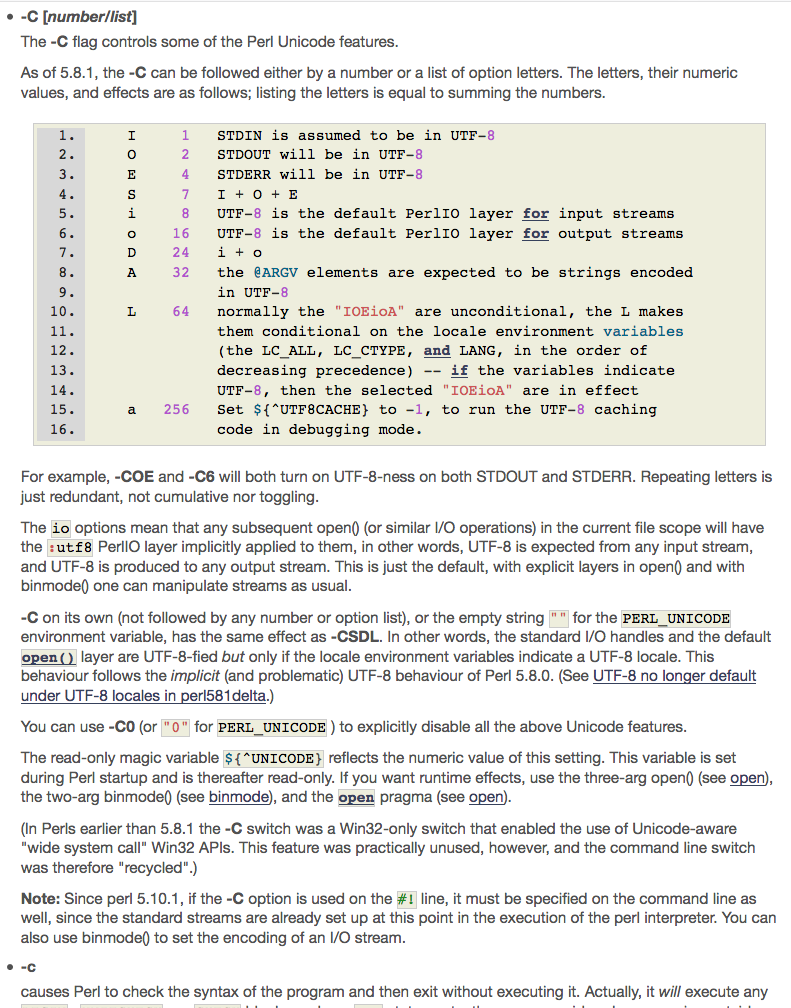
As of 5.8.1, the -C can be followed either by a number or a list of
option letters. The letters, their numeric values, and effects are
as follows; listing the letters is equal to summing the numbers.
I 1 STDIN is assumed to be in UTF-8
O 2 STDOUT will be in UTF-8
E 4 STDERR will be in UTF-8
S 7 I + O + E
i 8 UTF-8 is the default PerlIO layer for input streams
o 16 UTF-8 is the default PerlIO layer for output streams
D 24 i + o
A 32 the @ARGV elements are expected to be strings encoded
in UTF-8
L 64 normally the "IOEioA" are unconditional,
the L makes them conditional on the locale environment
variables (the LC_ALL, LC_TYPE, and LANG, in the order
of decreasing precedence) -- if the variables indicate
UTF-8, then the selected "IOEioA" are in effect
a 256 Set ${^UTF8CACHE} to -1, to run the UTF-8 caching code in
debugging mode.
For example, -COE and -C6 will both turn on UTF-8-ness on both
STDOUT and STDERR. Repeating letters is just redundant, not
cumulative nor toggling.
The "io" options mean that any subsequent open() (or similar I/O
operations) in the current file scope will have the ":utf8" PerlIO
layer implicitly applied to them, in other words, UTF-8 is expected
from any input stream, and UTF-8 is produced to any output stream.
This is just the default, with explicit layers in open() and with
binmode() one can manipulate streams as usual.
-C on its own (not followed by any number or option list), or the
empty string "" for the "PERL_UNICODE" environment variable, has
the same effect as -CSDL. In other words, the standard I/O handles
and the default "open()" layer are UTF-8-fied *but* only if the
locale environment variables indicate a UTF-8 locale. This
behaviour follows the *implicit* (and problematic) UTF-8 behaviour
of Perl 5.8.0.
You can use -C0 (or "0" for "PERL_UNICODE") to explicitly disable
all the above Unicode features.
The read-only magic variable "${^UNICODE}" reflects the numeric
value of this setting. This variable is set during Perl startup and
is thereafter read-only. If you want runtime effects, use the
three-arg open() (see "open" in perlfunc), the two-arg binmode()
(see "binmode" in perlfunc), and the "open" pragma (see open).
(In Perls earlier than 5.8.1 the -C switch was a Win32-only switch
that enabled the use of Unicode-aware "wide system call" Win32
APIs. This feature was practically unused, however, and the command
line switch was therefore "recycled".)
Note: Since perl 5.10.1, if the -C option is used on the "#!" line,
it must be specified on the command line as well, since the
standard streams are already set up at this point in the execution
of the perl interpreter. You can also use binmode() to set the
encoding of an I/O stream.
reading that is like a adventure. It's like this:
The -C is a key to unlock many secrets. Just get it, and you'll be all good to go, except in cases you may need the inner key. You'll find a hinge in the key, open it, then there's a subkey. On the subkey, there's a number. Take that number to the lock, it will open with keyX. When you use keyX, it must be matched with the previous inner key with 8th bit. keyX doesn't have a ID, but you can make one by finding the number at the place you found the key C. Key C is actually optional, but when inner key and keyX's number matches, it changes the nature of the lock. This is when you need to turn on keyMode …
If you have a question, put $5 at patreon and message me.