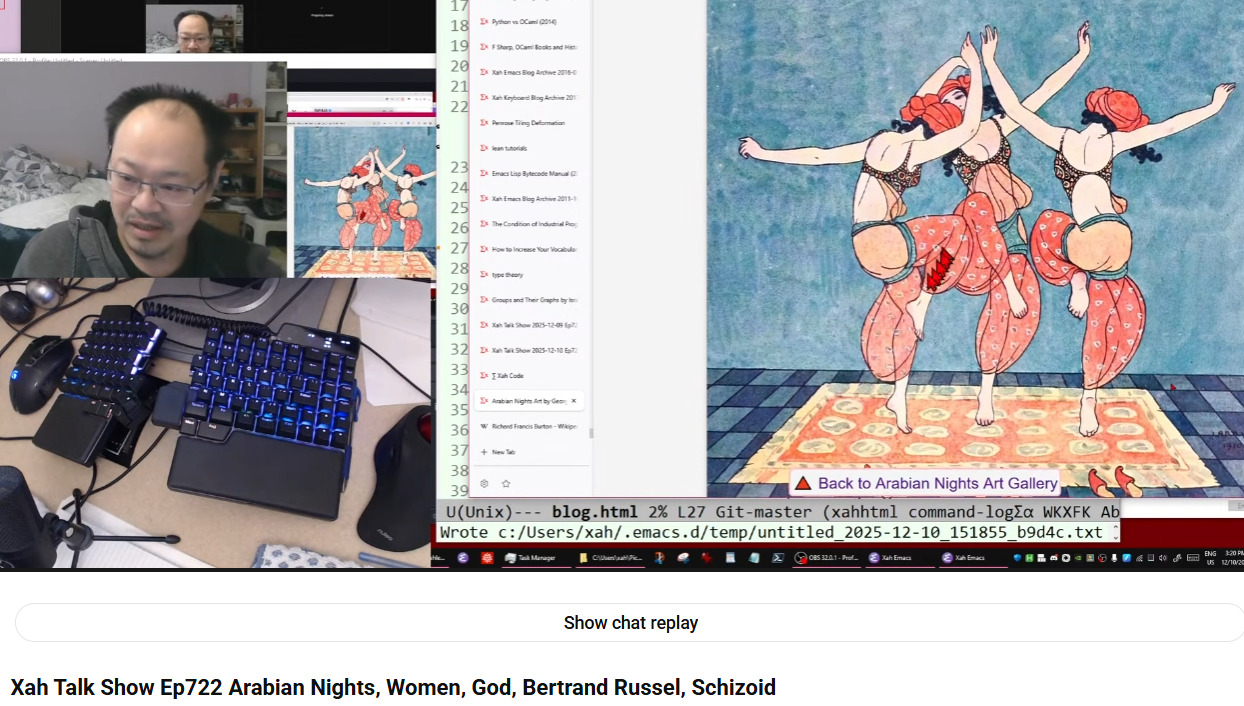
The video features Xah Lee discussing various topics, starting with an update on his coding project for Advent of Code 2025 (0:02).
He then introduces his website, xahlee.info, highlighting its extensive content on programming, mathematics, and literature (0:36-1:28).
A significant portion of the video is dedicated to a discussion about "Arabian Nights".
Xah Lee shares his experience reading Sir Richard Burton's translation, describing it as flamboyant and elaborate, using archaic English (1:33-1:41, 6:54-7:02).
He also explains that the original "Arabian Nights" is filled with themes of sex, slaves, and monsters, unlike the sanitized Disney versions (8:47-11:18).
He mentions that reading it helped him learn about English vocabulary, history, and different cultural perceptions, including those about women (13:41-16:38).
He contrasts Burton's version with Hussein Hatway's translation, which is supposedly simpler and more truthful, without emphasizing sexual content or archaic English (17:02-18:48).
Interestingly, Aladdin is not in the original Arabic manuscripts of "Arabian Nights", and Xah Lee found Burton's translation of Aladdin to be the least interesting story (18:57-21:50).
He also points out that many translations are censored, and the original work contains explicit content (21:50-25:30).
The video transitions to a Q&A session where Xah Lee answers audience questions (26:01).
He humorously proposes a new acronym, LIVOW (Linguistics, Literature, Vocabulary, and Writing), as a counterpart to STEM, to encourage women and minorities into these fields (27:05-28:21).
When asked about his belief in God, he explains his agnostic stance and shares how Bertrand Russell, a philosopher and mathematician, greatly influenced his views (28:30-35:24).
Finally, Xah Lee discusses the topic of friendship and reveals his own schizoid personality, describing himself as a loner who prefers solitary activities and finds small talk difficult (36:03-49:05).
He uses an AI summary to further explain the characteristics of schizoid personality disorder, noting that many of them apply to him, such as a lack of interest in close relationships and indifference to praise or criticism (49:07-53:15).
He concludes by offering advice on the importance of building long-term friendships as one gets older (43:36-44:41) and briefly touches on his work experience (54:05-55:23).