MathCurvesSurfacesWallpaper GroupsGallerySoftwarePOV-Ray
ProgramingLinuxPerl PythonHTMLCSSJavaScriptPHPJavaLang DesignEmacsUnicode ♥

Tools to Display Math on Web

, , ,

Discovered 2 new tools to write math for the web. Here's a list of them.

FireMath, a MathML Editor for Firefox

FireMath is a MathML editor as a Firefox plugin. Home at: www.firemath.info.

MathJax

MathJax. Home at: www.mathjax.org.

MathJax is an open-source JavaScript display engine for LaTeX and MathML that works in all modern browsers. It was designed with the goal of consolidating the recent advances in web technologies into a single, definitive, math-on-the-web platform supporting the major browsers and operating systems. It requires no setup on the part of the user (no plugins to download or software to install), so the page author can write web documents that include mathematics and be confident that users will be able to view it naturally and easily. One simply includes MathJax and some mathematics in a web page, and MathJax does the rest.

MathJax uses web-based fonts (in those browsers that support it) to produce high-quality typesetting that scales and prints at full resolution (unlike mathematics included as images). MathJax can be used with screen readers, providing accessibility for the visually impaired. With MathJax, mathematics is text-based rather than image-based, and so it is available for search engines, meaning that your equations can be searched, just like the text of your pages. MathJax allows page authors to write formulas using TeX and LaTeX notation, or MathML, a World Wide Web Consortium standard for representing mathematics in XML format. MathJax will even convert TeX notation into MathML, so that it can be rendered more quickly by those browsers that support MathML natively, or so that you can copy and past it into other programs.

MathJax is used by Math Overflow. See: Source mathoverflow.net.

mathurl.com

There's a extremely simple, nice, web site for creating math notations then you can point a URL to. You type LaTeX code, it displays the results as a image on-the-fly immediately as you edit. It also comes with a short perm URL that you can point to. You can come back to the URL later and edit the expression anytime. The site is at mathurl.com.

Detexify

Detexify is a tool that lets you draw a math symbol and it shows you the code for LaTeX. The tool is created by Daniel Kirsch @ detexify.kirelabs.org.

Entering Math Symbols

See:

If you are a emacs user, see:

Mathematica

Of course, you can get Mathematica. Student or hobbyist can get it for ≈$295. This is the most robust, convient, powerful, professional, solution. (i'm a dedicated Mathematica fan)

Mathematica home page at: wolfram.com.

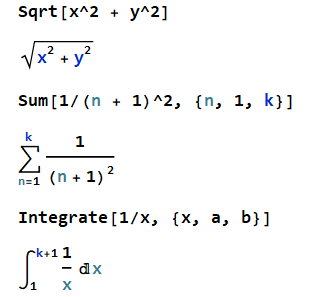
For a example of its output, in PDF, HTML, MathML/XML, see: Math Typesetting, Mathematica, MathML.

Other

For a list of more, see: Formula editor.

Rant

The technology to display math notation on the web browser, is really dismal. MathML is released in 1998. Now, it is over 10 years, but it is still not widely supported in web browsers. Authors need to invest huge amount of time experimenting with several solutions, and in most cases, requires knowledge of html, css, xml, MathML, JavaScript, TeX, to various degrees. One early solution is to resort to some tool to turn math notations into images. This means, the browser needs to load a huge bunch of images, and the images are ugly, not scalable, cannot be copy and pasted. Images for math notation are still widely practiced today. Another solution requires readers to download some special plug-in. Another solution is to simply discard the web and use PDF instead.

In the past 10 years, huge amount of web technologies have developed, from blog to wiki to instant messaging to Twitter to interactive road maps to online videos to voice and video chats. Digital video is much more technically complex than math display system, but when it comes to math, sadly, the situation is rather stagnant. This is, of course, because relatively very few people need it. Perhaps 0.01% of web users.

What Wikipedia Use?

Wikipedia, which is the largest math encyclopedia online, uses images mixed with some html. (See: Help:Displaying a formula) More specifically, it uses a home cooked markup <math>‹expression›</math>, where the ‹expression› is a subset of simple LaTeX code, and on-the-fly it processed by Texvc to generate images with some html markup.

blog comments powered by Disqus