Boy's Surface (Apery)
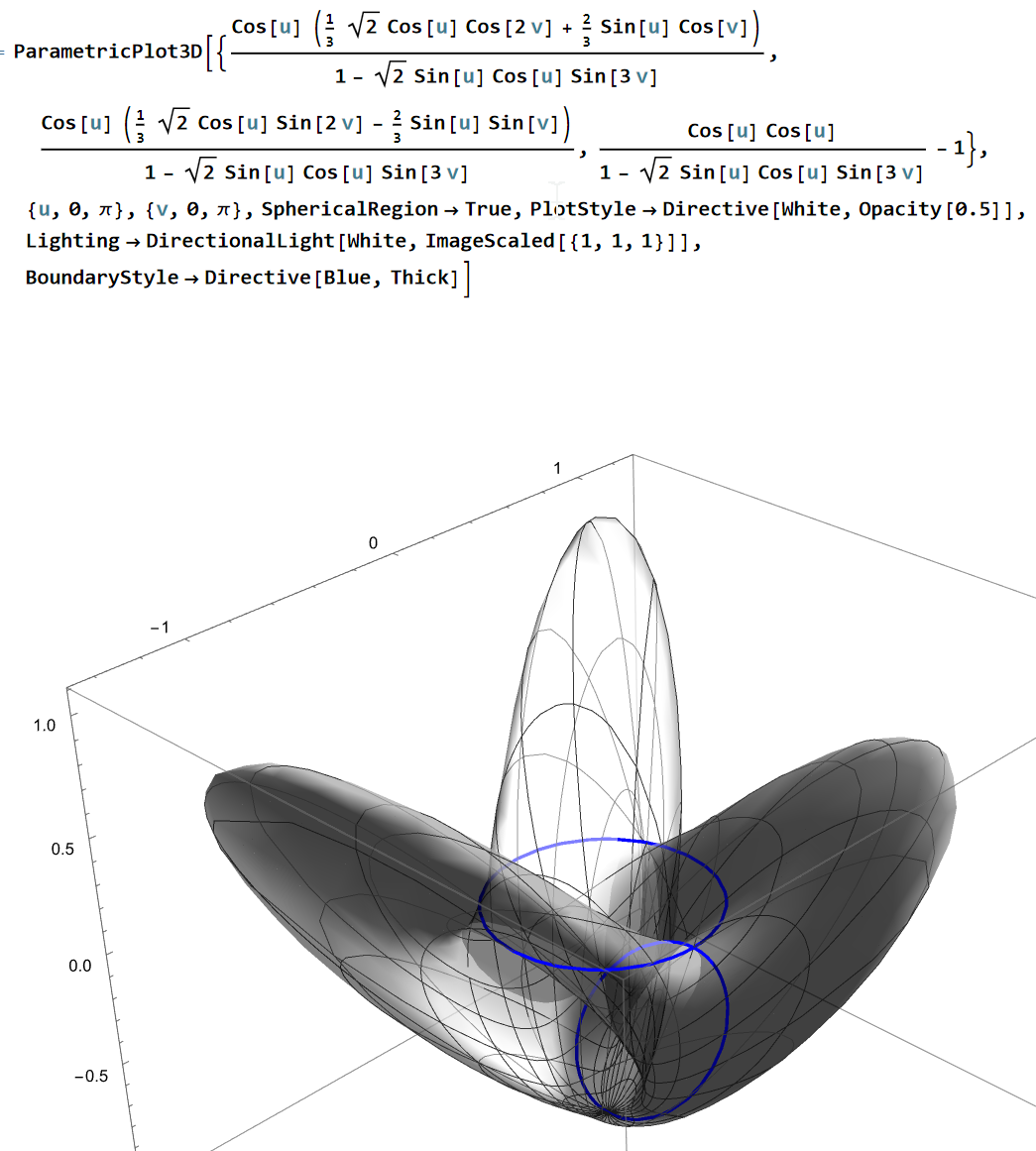
ParametricPlot3D[
{(Cos[u]*((1/3)*Sqrt[2]*Cos[u]*Cos[2*v] + (2/3)*Sin[u]*Cos[v]))/ (1 - Sqrt[2]*Sin[u]*Cos[u]*Sin[3*v]),
 (Cos[u]*((1/3)*Sqrt[2]*Cos[u]*Sin[2*v] - (2/3)*Sin[u]*Sin[v]))/ (1 - Sqrt[2]*Sin[u]*Cos[u]*Sin[3*v]),
 (Cos[u]*Cos[u])/(1 - Sqrt[2]*Sin[u]*Cos[u]*Sin[3*v]) - 1},
 {u, 0, π}, {v, 0, π},
SphericalRegion -> True,
PlotStyle -> Directive[White, Opacity[0.7]],
Lighting -> DirectionalLight[White, ImageScaled[{1, 1, 1}]],
BoundaryStyle -> Directive[Blue, Thick]
]
This surface is topologically equivalent to the Cross-cap, Boy's (Bryant-Kusner) surface, Steiner Surface. They are all real models of the projective plane, immersed in 3D space.
The most simple visualization of projective plane as a real surface in the Cross Cap, which is basically a semi-sphere with the rims sewed together. The Cross Cap has sigularities. That is to say, two points on the surface are special in some way. Boys (Apery) surface is one without such singulary. (but has other type of special point in the center.)
What is the significance of Boy's Surface (AI Generated)