Boy's Surface (Bryant-Kusner)

ParametricPlot3D[
  With[{z = u + I v},
    Function[v, (v / (v . v))] @ Re[
      {0, 0, 1/2} +
      {I z (1 - z^4), z (1 + z^4), -(2 I/3) (z^6 + 1)} /
      (z^6 + Sqrt[5] z^3 - 1)
    ]
  ],
  {u, -1, 1}, {v, -1, 1},
SphericalRegion -> True,
PlotPoints -> 80,
PlotStyle -> Directive[White, Opacity[0.7]],
Lighting -> DirectionalLight[White, ImageScaled[{1, 1, 1}]],
BoundaryStyle -> Directive[Blue, Thick],
Axes -> None,
Boxed -> False
]
This surface is the Boys Surface with a parametric formula by Bryant-Kusner.
It is topoligically equivalent to the Cross-Cap Surface .
What is the significance of Boy's Surface (Bryant-Kusner parameterization) (AI Generated)
what is the significance of Boy's Surface (Bryant-Kusner parameterization).
Boy's surface is a famous immersion (smooth, locally one-to-one map) of the real projective plane \(\mathbb{RP}^2\) into \(\mathbb{R}^3\). It cannot be embedded without self-intersections (because \(\mathbb{RP}^2\) is non-orientable), but it can be immersed, and Boy's surface gives an explicit geometric model of this fact.
Historical and topological significance
In 1901, German mathematician Werner Boy, working on his doctoral thesis under David Hilbert at Göttingen, constructed the first known immersion of \(\mathbb{RP}^2\) in 3-space. Hilbert had suspected it might be impossible and asked Boy to prove impossibility; instead, Boy found the opposite.
Topologically, Boy's surface is equivalent to a disk glued to a Möbius strip along their boundaries (or, equivalently, the 2-sphere with antipodal points identified). Like the Klein bottle or cross-cap, it is non-orientable, contains a Möbius band, and must self-intersect when realized in \(\mathbb{R}^3\). It has:
- one triple point (three sheets meeting),
- curves of double points,
- but no pinch singularities (it is a smooth immersion everywhere).
It is one of only three classical “standard” models of \(\mathbb{RP}^2\) in 3-space (the others being the cross-cap and Roman surface).
Its discovery was a landmark in differential topology and visualization of non-orientable surfaces. It is still used today in mathematical art, 3D printing, and sculptures (e.g., the large metal model at the Mathematisches Forschungsinstitut Oberwolfach).
Bryant–Kusner parameterization and its special significance
The original description by Boy was purely qualitative (pictures and topological construction). Explicit parametric equations came later. The version now called the Bryant–Kusner parameterization (discovered by Robert Bryant and Rob Kusner in the 1980s) is particularly elegant and important.
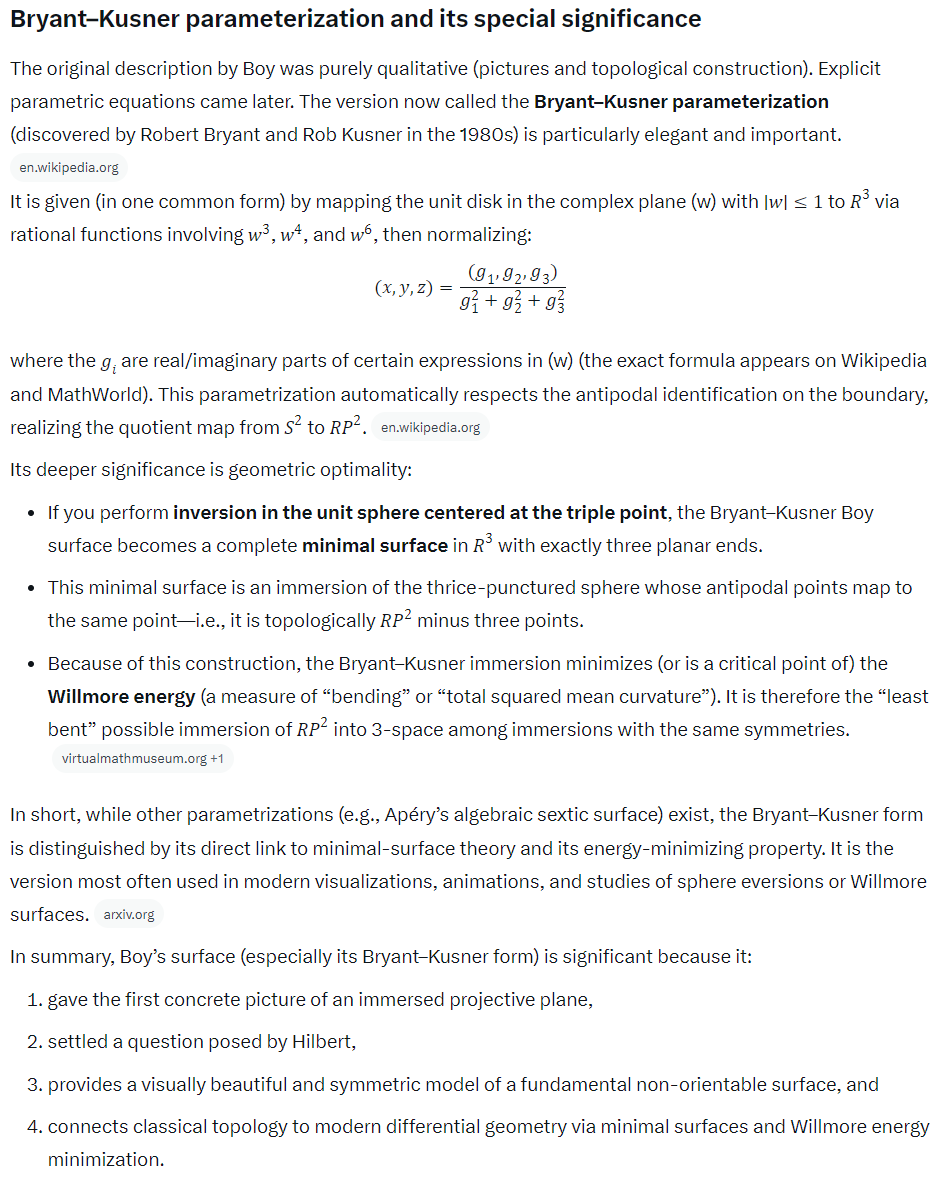
It is given (in one common form) by mapping the unit disk in the complex plane \(w\) with \(|w| \leq 1\) to \(\mathbb{R}^3\) via rational functions involving \(w^3\), \(w^4\), and \(w^6\), then normalizing: \[ (x,y,z) = \frac{(g_1, g_2, g_3)}{g_1^2 + g_2^2 + g_3^2} \] where the \(g_i\) are real/imaginary parts of certain expressions in \(w\) (the exact formula appears on Wikipedia and MathWorld). This parametrization automatically respects the antipodal identification on the boundary, realizing the quotient map from \(S^2\) to \(\mathbb{RP}^2\).Its deeper significance is geometric optimality:
- If you perform inversion in the unit sphere centered at the triple point, the Bryant–Kusner Boy surface becomes a complete minimal surface in \(\mathbb{R}^3\) with exactly three planar ends.
- This minimal surface is an immersion of the thrice-punctured sphere whose antipodal points map to the same point—i.e., it is topologically \(\mathbb{RP}^2\) minus three points.
- Because of this construction, the Bryant–Kusner immersion minimizes (or is a critical point of) the Willmore energy (a measure of “bending” or “total squared mean curvature”). It is therefore the “least bent” possible immersion of \(\mathbb{RP}^2\) into 3-space among immersions with the same symmetries.
In short, while other parametrizations (e.g., Apéry’s algebraic sextic surface) exist, the Bryant–Kusner form is distinguished by its direct link to minimal-surface theory and its energy-minimizing property. It is the version most often used in modern visualizations, animations, and studies of sphere eversions or Willmore surfaces.
In summary, Boy’s surface (especially its Bryant–Kusner form) is significant because it:
- gave the first concrete picture of an immersed projective plane,
- settled a question posed by Hilbert,
- provides a visually beautiful and symmetric model of a fundamental non-orientable surface, and
- connects classical topology to modern differential geometry via minimal surfaces and Willmore energy minimization.