Steiner Surface
Roman surface is topologically equivalent to Boy's surface Apery, Boys (Bryant-Kusner) surface, Cross-cap. It has tetrhedron symmetry.
Algebraci equation:
incorrect.
ContourPlot3D[
x^2* y^2 + y^2* z^2 + z^2* x^2 - r^2* x* y* z == 0
,
{x, -2, 2}, {y, -2, 2}, {z, -2, 2},
PlotRange -> All,
PlotPoints -> 80,
Axes -> False,
Boxed -> False,
ContourStyle -> Directive[RandomColor[], Opacity[1], Specularity[1, 20]]]
ContourPlot3D[ x^2* y^2 + y^2* z^2 + z^2* x^2 - r^2* x* y* z == 0 , {x, -4, 4}, {y, -4, 4}, {z, -4, 4} ]
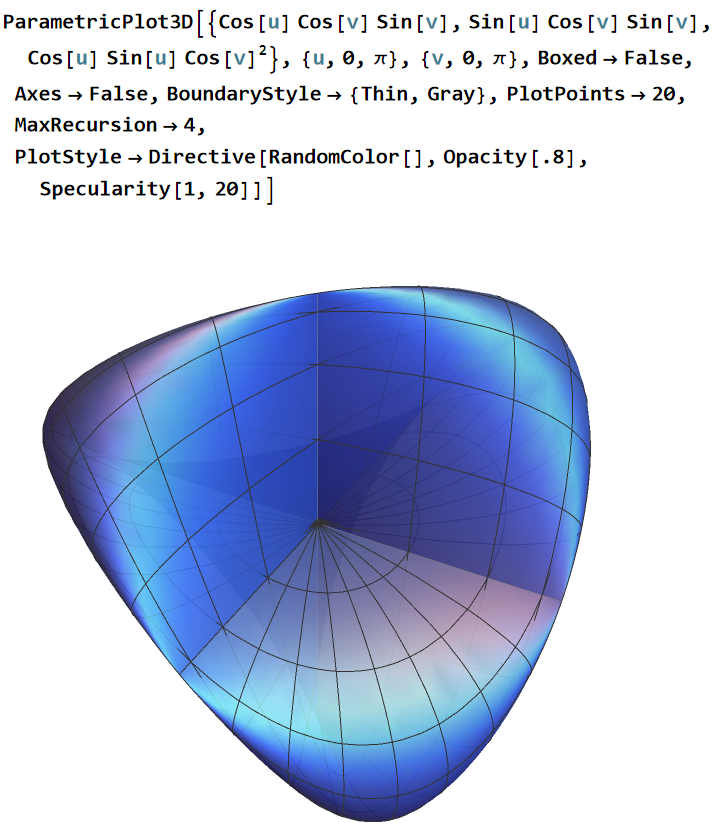
ParametricPlot3D[
{Cos[u] Cos[v] Sin[v],
Sin[u] Cos[v] Sin[v],
Cos[u] Sin[u] Cos[v]^2},
 {u, 0, Pi}, {v, 0, Pi},
Boxed -> False, Axes -> False,
 BoundaryStyle -> {Thin, Gray}, PlotPoints -> 20, MaxRecursion -> 4,
 PlotStyle ->
  Directive[RandomColor[], Opacity[.8], Specularity[1, 20]]]
Here is a smooth deformation from Boy's surface to Roman surface, with b from 0 to 1. (formula from Peter Wang)
incorrect
Table[
ParametricPlot3D[
{Sqrt[2]*Cos[2*u]*Cos(v)^2+Cos[u]*Sin[2*v]/(2-(b*Sqrt[2]*Sin[3*u]*Sin[2*v])),
 Sqrt[2]*Sin[2*u]*Cos(v)^2-Sin[u]*Sin[2*v]/(2-(b*Sqrt[2]*Sin[3*u]*Sin[2*v])),
 3*Cos[v]^2/(2-(b*Sqrt[2]*Sin[3*u]*Sin[2*v]))-1}
,
 {u, 0, Pi}, {v, 0, Pi},
Boxed -> False, Axes -> False,
 BoundaryStyle -> {Thin, Gray}, PlotPoints -> 20, MaxRecursion -> 4,
 PlotStyle ->
  Directive[RandomColor[], Opacity[.8], Specularity[1, 20]]],
 {b, 0, 1, 0.2}]