Xah Talk Show 2025-12-11 Ep723 Wolfram Language, Advent of Code 2025, Day 1, Part 2, take 2
- Wolfram Language in Depth (tutorial)
- Wolfram: Download Wolfram Engine
- Emacs: Xah Wolfram Mode 📦
- Emacs: Xah Fly Keys 📦
Why Wolfram language QuotientRemainder[-10,3] return {-4, 2}, not {-3, 1}
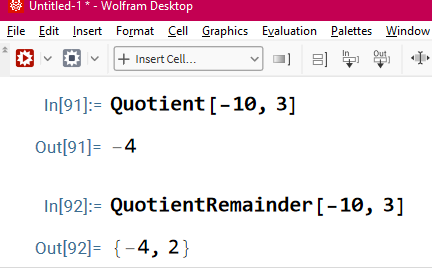
QuotientRemainder[10,3]
(* {3, 1} *)

(* why does this not return {-3, 1} *)
QuotientRemainder[-10,3]
{-4, 2}

Quotient[-10,3]
(* -4 *)
because, it is to be consistent with Quotient function, and the Quotient function doc says:
Quotient[m,n] gives the greatest integer no larger than m/n.
in other words, it rounds using Floor.
why quotient(10,-3) return -4, not -3
- when doing quotient(10,-3) why does it return -4, not -3.
- what is the math convention, for quotient(-10,3) to return -3 or -4
- https://x.com/i/grok/share/CQV0w07CHxzYTpSs37s2PfHZk
grok gave several incorrect answer.
- 1. there is is no math.quotient in python.
- 2. grok ai saying that JavaScript quotient function truncates towards 0, is incorrect. because in JavaScript, there is no integer quotient function.
- 3. the reason it says the convention is remainder to be non-negative, but quotient(-10,3) return -3 is also valid, because -3*-3 = 9+1.
print(10 // 3)
# 3

print(-10 // 3)
# -4
Clear[xOperation]

xOperation::usage="xOperation[currentNumber, rotateN]
returns a list
{c,d}
c is the number of times it passed 0.
d is the new index number.";

(* this function is incorect.
when, currentNumber is 0 , and the result index number is also 0.
in this case, the returned value First Part sould minus 1.
 *)

xOperation[currentNumber_, rotateN_] :=
QuotientRemainder[(currentNumber + rotateN) , 100]

xOperation[0,0]
(* {0, 0} *)

xOperation[0,5]
(* {0, 5} *)

xOperation[0,100]
(* {1, 0} *)

xOperation[0,101]
(* {1, 1} *)

xOperation[0,-100]
(* {-1, 0} *)

xOperation[5,0]
(* {0, 5} *)

xOperation[5,-4]
(* {0, 1} *)

xOperation[5,-5]
(* {0, 0} *)

xOperation[5,-6]
(* {-1, 99} *)

xOperation[5,-99]
(* {-1, 6} *)

xOperation[5,-100]
(* {-1, 5} *)

xOperation[5,-600]
(* {-6, 5} *)

xOperation[5,5]
(* {0, 10} *)

xOperation[5, 600]
(* {6, 5} *)