This page is a review on several computer keyboards that are often buzzed about by “hacker” subculture of programers.
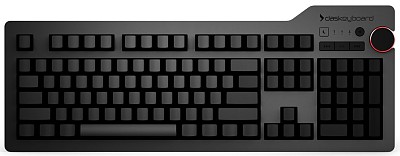
The Das Keyboard. Famous for being a keyboard with no key labels.
Good as a novelty, nothing else.
How much to pay to impress friends? $129!
How did this keyboard came about? According to the official site daskeyboard.com, the programer and company founder Daniel Guermeur, wanted to learn touch typing. The first thing is to get rid of the key labels, and the rest is history. Quote:
In 2005, in a personal quest to improve his own typing speed and accuracy, Metadot Corporation founder and self-proclaimed “Uber Geek” Daniel Guermeur asked to have a totally blank keyboard created. To his surprise, his typing speed doubled after just a few weeks of use.
As many friends and colleagues who tested the keyboard were mesmerized and wanted one, the business potential became obvious, and Das Keyboard was born.
For the first few years, the company doesn't do key labels. But since about 2008, they started to sell models that have key labels. The reason seems obvious. Without labels, you might sell 1 for every ten thousand programers. But with labels, your sales potential immediately increases by 1000.
Also, they introduced mechanical switch for the keys so that you get a good tactile feedback. The “Model S Professional” uses Cherry MX Blue switch, which is very clicky. 〔☛ Guide to Computer Keyboard Key Switch Mechanisms〕
However, i've seen one youtube video that shows a problem of the click-clack mechanism. For some keys, it makes a extraneous click when you put pressure on it. Not sure if that's just a single case of defective device, or defective design. Watch this, this is funny:
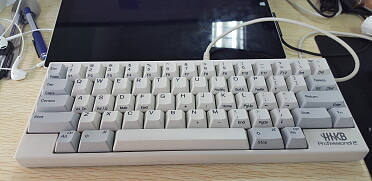
The Happy Hacking Keyboard. The worst keyboard possible. No function keys, no number keypad, no {↖ Home, ↘ End, ⇞ Page △, ⇟ Page ▽, ⌫ Backspace} keys, and fewer modifier keys. A earlier model does not even have arrow keys.
So, when you need to press F1, now you need to press 2 keys, by holding Fn then press 1. Hacker Progress?
Like other weird keyboards, this one has some kinda hacker association, and is often reviewed on geek sites. Occasionally, you see programers on the web claiming how they love this keyboard.
The name “happy hacking” is probably responsible for boosting its popularity among “hackers”, with the ostensible absence of the Microsoft Windows logo on that modifier key. This makes it popular among linux users. If you own one, you can strike a conversation with it.
I got curious about this keyboard's history. Apparently, it's made by PFU Systems, and the website states: “a Fujitsu company”, of Japan. Quote:
PFU Systems, Inc. is the U.S. subsidiary of PFU Ltd. of Japan.
That somewhat makes it understandable. If you have visited Japan, you'll notice that everything comes in a miniaturized size. Cars, roads, furniture, office equipment, rice bowels, chopsticks, …, etc.
Cost? About $70.
For detail of this keyboard's problem, see: Happy Hacking Keyboard Review.
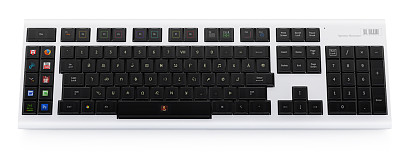
Optimus Maximus keyboard. A keyboard with the feature of having a display on each key.
The display are not just simplistic LEDs. They can even display video. Each key features a 48×48 pixels display, updated 10 times per second.
Effectively, the key labels are dynamic and can change, great if you are a heavy key macros user (programer and gamer). Unfortunately, there are many practical problems. Not ergonomic.
The official site has a Flash app keyboard toy you can play with. @ artlebedev.com
How much? $1800. It's art!!
see IBM Model M keyboard, Unicomp